
A History of Pathologists' Assistants, Their Profession &
The American Association of Pathologists' Assistants
Introduction
This general historical perspective and several early timeline items below are meant to acquaint the reader with milestones and events that led to and influenced the development and establishment of the Pathologists' Assistant and Physician's Assistant professions. The bulk of the chronological timeline however, describes events and milestones specific to the pathologists' assistant profession as well as the creation and ongoing development of the American Association of Pathologists' Assistants (AAPA).
Timeline
A Brief History
The utilization of non-physicians to provide primary health care services in countries around the world has a long and significant history, dating back at least as far as the 1600s. Often, the need was created because of wars and large numbers of battlefield casualties. Manpower shortages also made it difficult to provide services in rural areas. In the United States, utilization of non-physicians was recognized and accepted, particularly in the US Navy in the late 1790s. In 1799 the U.S. Congress passed a bill authorizing the U.S Navy to use "hospital mates" to assist physicians in the care of navy personnel, particularly at sea. That name changed to "surgeon's stewards" and eventually to what we are familiar with today, "hospital corpsmen". Specialization in medical practice increased significantly post World War II, and a growing shortage in primary care givers was clearly recognized. To further compound the problems caused by shortage of healthcare workers, millions of new potential patients suddenly gained access to healthcare services upon the creation in 1965 of Medicare and Medicaid. read more..
The utilization of non-physicians to provide services in anatomic pathology, specifically in the performance of the autopsy (the word autopsy derives from the ancient Greek "autopsia" which means ("to see with one's own eyes") dates as far back as ancient times. [1]Around 3000 BC the ancient Egyptians, utilizing non-physician embalmers, were one of the first civilizations to remove and examine human internal organs in the religious practice of mummification. [2] Other non-physicians, such as dieners (diener derives from the German word leichendiener, which literally translates to "corpse servant"), were utilized in medieval times. [3] Interestingly, an autopsy assistant (diener) is depicted in Rembrandt's 1656 painting entitled "The Anatomy Lesson of Dr. Jan Deijman". [4] In the mid nineteenth century Rudolf Virchow notably espoused a systematic approach to the performance of autopsies. He noted that in his experience autopsies were at that time being performed with no regular method, principally by young and untrained surgical assistants. [5]
In the early twentieth century the autopsy was viewed as an invaluable tool in the education of physicians, particularly regarding the correlation between clinical history and autopsy findings. A hospital's accreditation was often based upon its autopsy rates. [6] Post-World War II, the numbers of "routine" hospital autopsies rose significantly, consequently increasing the burden on pathologists. [6]
Projected manpower shortages among the ranks of primary care physicians and pathologists in the United States during the 1950s and 1960s brought about the establishment of training programs in the mid and late 1960s for both physician assistants and pathologists' assistants. These programs were the foundation upon which two similar, but distinct professions were built. It is worthy of note that a major concern voiced by both clinicians and pathologists at the time was that neither physician's assistants nor pathologists' assistants should be doing medical work. [7] The manpower shortages and projected shortages in the mid-to-late 1960s came at a time when thousands of military corpsmen and medics were returning from service in Vietnam to civilian life. [8] The early physician assistant programs relied on this ready-made population of well-trained ex-military corpsmen as a pool of candidates for their training programs. [9] Early pathologists' assistant programs also recruited from this population, though to a lesser degree.
Physician extenders, particularly in the anatomic pathology setting, were also needed in the United Kingdom during this 1960s. One British pathologist's answer to the manpower shortages was to suggest in a 1972 correspondence to the Lancet, the introduction of "necropsy technologists", who after training and under the supervision of a pathologist, would be a part of a post-mortem pathology team in much the same way that surgical pathology is so successfully dealt with. [10] collapse
-
1898
The U.S. Congress authorizes the establishment of the U.S. Navy Hospital Corps.
-
1943
The U.S. Surgeon General establishesthe position of "Battalion Surgeon's Assistant".
-
1960
The American Medical Association (AMA) proposes the training of former US Navy Hospital Corpsmen as assistants to physicians.
-
1961
The American Medical Association (AMA) calls for a “mid-level” provider from the ranks of ex-military corpsmen.
-
1965
The United States Congress passes Medicare and Medicaid.
Eugene A. Stead Jr, MD, at Duke University, Durham, NC creates the first formal training program for physician’s assistants. The first class consists of four ex US Navy Hospital Corpsmen.
-
1967
The University of Alabama, Birmingham, AL establishes the first "Surgeon Assistant" program.
-
1968
The American Association of Physician’s Assistants (AAPA) is established by Duke University students and alumni.
-
1969
The University of Washington, Seattle, WA establishes the MEDEX programs, designed to provide healthcare to rural areas in the northwest.
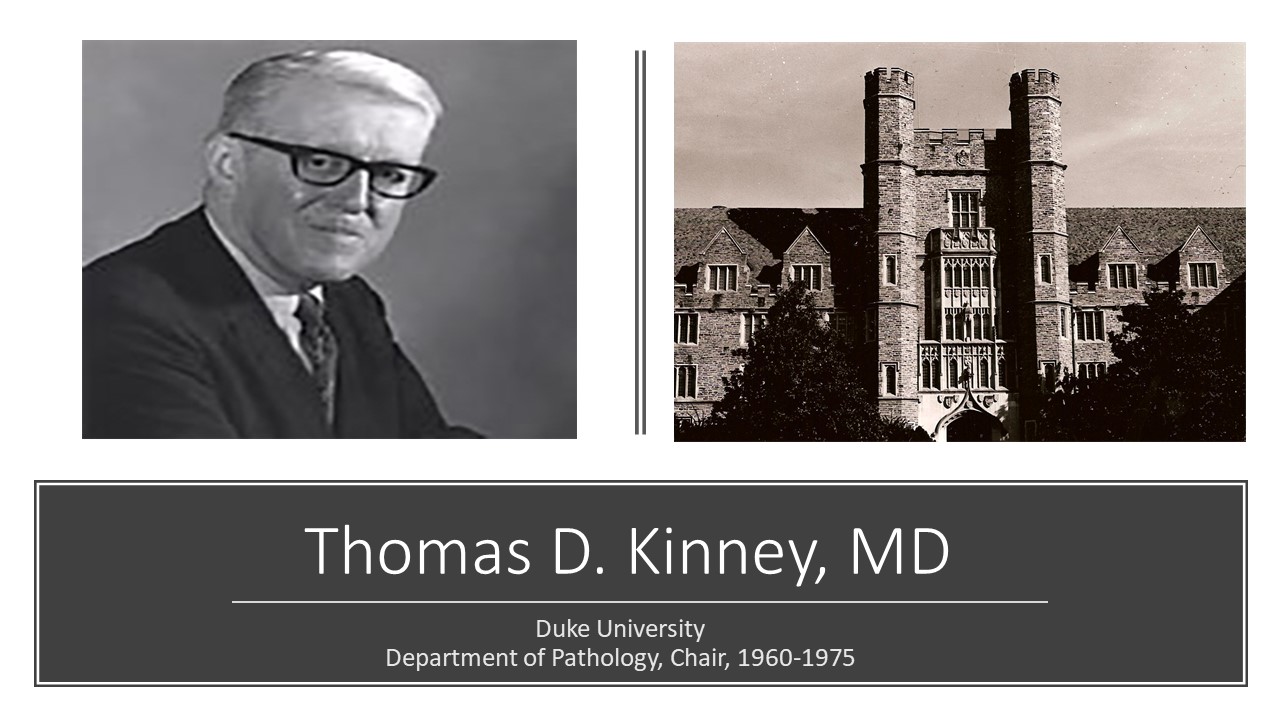 A Veterans Administration grant enables Thomas D. Kinney, MD, at Duke University to develop the first formal pathologists' assistant training program in partnership with the Veterans Administration Medical Center (VAMC) in Durham, North Carolina in July of 1969. read more1
 -
1970
A Veterans Administration grant enables the establishment of a second pilot pathologists' assistant program, involving the University of Alabama (UAB) in partnership with the Veterans Administration Medical Center (VAMC) in Birmingham, Alabama. read more2
-
1971
The American Medical Association (AMA) formally endorses the "physician's assistant" concept.
A Veterans Administration grant enables the establishment of a third pilot pathologists' assistant program, involving the West Haven Veterans Administration Medical Center (VAMC) in partnership with Yale University and Quinnipiac College.
read more3The American Medical Association (AMA) and the American Hospital Association (AHA) recommend a moratorium on licensure of additional health occupations.
A group of practicing pathologists' assistants, seeking to organize themselves and to advance the newly emerging profession approachesthe American Association of Physician's Assistants (AAPA) about becoming members. The Physician's Assistants organization declines the request and shortly thereafter copyrights their "PA-C" designation for "Physician Assistant, Certified".