|
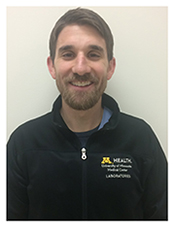 Drew Sciacca, PA(ASCP)CM Drew Sciacca, PA(ASCP)CM
AAPA member since 2012
“Within the anatomic pathology departments throughout the M Health Fairview system, there is a daily call-in meeting at 8:30 a.m. led by our System Operations Director, which helps communicate COVID-19 information to all labs and locations. Information shared includes number of cases within our state and health care system, key specimens the infectious prevention department has labeled as requiring additional precautionary PPE, as well as sharing questions regarding staffing changes.
Patients testing positive for COVID-19 within the health care system are moved to a short-term acute care hospital that was retrofitted from a long-term care hospital allowing for all patients to have specialty intensive care in a single location. Current specimens within the gross room that are handled with additional precautionary measures include lung specimens, intestinal resections, and oral and nasal cavity specimens. When these are received, the specimens are handled within our biosafety cabinet (BSC), wearing standard PPE (impermeable gown, gloves, and eyewear) and N95 masks. Any specimens not able to be handled within the BSC are handled at regular grossing stations with standard PPE, N95 mask, and face shield. Updated policies concerning specimen handling are sent in a document that is updated frequently with any new changes or pertinent information. Also, to increase communication between the ORs and gross room, any infection with COVID-19 and TB, in addition to any isolation status, will be listed on the received requisition. The N95 masks used when handling these specimens are stored for later use in individual paper bags. For residents, fellows, and PAs who despise shaving daily like myself, we have looked into ordering PAPRs that will be stored for readily available lab use and not take the limited amount our supply chain has available.
Typically at the University campus, the five PAs will cover three different gross rooms; however, with the reduction in elective surgeries, one site closed their ORs resulting in no longer staffing the gross room. For any clinics that remained open at this site, a courier was set up to bring specimens to the main lab on campus. On the remaining two sites, elective surgeries have greatly reduced with an initial slight drop in larger cancer resections. However, over the past three weeks a new standard of cases has been established. The schedule is adapted weekly to meet these needs while complying with social distancing by assigning individual office hours, placing two PAs and a resident in the main campus lab and single PA within the second lab. Scheduled office hours and downtime within the lab has resulted in time to update our photo database available for pathologist’s lectures at the medical school, revise all upcoming resident lectures given by PAs, plan the July introduction month for residents, examine all sections of the grossing manual making appropriate edits and additions, and start/finish projects that are necessarily delayed during busier times. The autopsy service during this time continues to remain at a normal level, and testing for COVID-19 is done on a case-by-case basis, based on the clinical history of the deceased. Our facility is not equipped to handle any positive COVID-19 cases, but regardless of the test result, all autopsies require wearing a N95 mask in addition to our standard PPE. Currently, we are examining ways to expand our morgue cooler storage in preparation for a higher demand.
Additional changes within our department have included remote work waiver approval for the pathologists where nearly all of the slides are viewed through whole slide imaging and signed out remotely. Our residency program also has formed platoons where one week out of three they will be present within the lab rotating within the gross room and autopsy service, as well as assisting in signing out cases. The other two weeks the residents are able to view the slides remotely, assist in signing out cases, and attend educational meetings directed by the pathologists through video communication software.
Outside of work, I am grateful that even with the stay-at-home order for the state, the city of Minneapolis has responded by closing down streets around lakes and along the Mississippi River in order for others to remain active while keeping social distance. Personally, the pandemic has resulted in the high possibility of cancelling my wedding scheduled for the beginning of June. As disappointing as this may seem, I must remind myself of all the challenges others are going through during this difficult time and how grateful I am to work with a cohesive, adaptive PA group. Hope everyone in the PA community is staying safe and healthy!“
We want to hear from you! During this time of isolation, now more than ever we need to see and hear from our PA community! How is COVID-19 affecting your work? What tips and tricks have you found useful? How are you using this time to promote pathologists’ assistants? Send us a summary describing your “new normal”, along with one or two high-resolution photos, and your story may be featured next (read previous features here). Or, if you have any COVID-19 resources to add to our list, please pass them along. Remember, we are all in this together, and the AAPA will be here to support you throughout this crisis and beyond.
Would you like to be featured in ASCP BOC’s new campaign? As a tie in with Lab Week, the ASCP BOC is seeking to honor the heroic efforts of laboratory professionals from around the world who are engaged in the fight against COVID-19. They are asking for pictures, stories, and/or videos that can be shared on their social media channels throughout this crisis. Click here to learn more; submit your story to [email protected].
Submission guidelines: There are no strict submission guidelines or criteria (submissions can be about anything people are doing to combat COVID-19). But some examples of what you could send are: how laboratory workers are keeping themselves safe, how they are encouraging good hygiene and hand washing, how they are using humor to relieve stress, how they are raising awareness of the medical laboratory profession in the midst of this pandemic, etc.
|