|
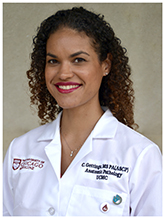 Charlene Gettings, PA(ASCP)CM Charlene Gettings, PA(ASCP)CM
AAPA member since 2010
“My experience with the COVID-19 pandemic comes from the perspective of a laboratory manager at an academic hospital in Chicago. Our Hospital Incident Command System (HICS) was activated in mid-January. Part of that activation included establishing a resource center on our internal intranet page wherein all our COVID-19 communications are consolidated. This was extremely helpful since the HICS Update emails increased from a few sent sporadically in early March to multiple e-mails sent daily by mid-March. This was an overwhelming situation that left little time to digest the disseminated message and factually explain the practicalities and impact to our laboratories’ personnel.
By mid-March, our workload census decreased dramatically because of cancellations of elective procedures and the postponement of cancer surgeries. Meanwhile, we implemented a number of ‘low census’ activities such as SOP revisions and creations, cross training, completion of competency assessments, updating training materials, organizing and cleaning all workspaces, scanning a backlog of paperwork, organizing files on the shared drives, organizing legal specimen storage, filing of slides and blocks, slide send-backs, CAP preparation, providing support to the microbiology lab (in-house testing for COVID-19), etc. We were still ‘essential’ employees coming to work each day to follow our usual schedules while waiting for other areas of the hospital to stabilize as the decreased census had a domino effect and didn’t halt all areas at once. However, the dictate to social distance and work from home recommendations issued by the HICS Updates, combined with the Governor of Illinois’ declaration to ‘shelter in place’ on March 20th took a final toll on staff. Tensions ran high in the labs until we implemented our rotating ‘reserve’ schedules.
Aside from my daily responsibilities as a manager, and although COVID-19 activities took on a major focus, there were many other pressing tasks that needed my attention. In early February to mid-March, a local Teamsters election took place involving laboratory staff and other ‘technical’ positions across the hospital with the outcome of the vote having a direct impact on my area. The end of February and early March included preparation for the annual USCAP meeting and exhibiting at the AAPA booth. As the climate of the COVID crisis evolved, I had to tell PAs that they could no longer attend the AAPA Spring Meeting. As an AAPA volunteer and member of the BOT, this was not an easy task that also needed attention. However, my most overwhelming responsibility was the completion and relocation of our entire morgue and autopsy operations to a newly reconstructed space, a project that was over a year in the making.
Rachel Poon (fellow PA and colleague) and I were in the home stretch coordinating a series of trainings on new equipment with vendors and stakeholders outside of pathology, validating new equipment, creating signage and job aides, reworking existing and creating new SOPs, etc., for a go-live date of March 30th. A few team members on the project in disciplines outside of pathology asked if we should postpone the project until after the pandemic crisis. Rachel and I insisted that the crisis was the main reason we needed to continue as scheduled. The morgue capacity in our 92-year-old space was 16 decedents (not including fetal/infant) and our new space has a capacity for 37 with some wiggle room to accommodate a few more on cadaver carts or beds. Within the first week of our go-live, we completed three routine autopsies in our new space. Even with extensive planning, we encountered a few hiccups. Imagine moving into a new kitchen with all new appliances and cookware, putting everything away so that it looks fabulous only to find that when it was time to cook your first elaborate meal, things had to be rearranged in order to improve the workflow.
During this time, we breathed a sigh of relief with regard to autopsy because the Cook County Medical Examiner announced that all COVID-19 positive and ‘patients under investigation’ (PUI) would fall under the jurisdiction of the Medical Examiner’s office under the criteria for ‘posing a threat to public health’. COVID-19 positive cases would be a records review only (no remains sent to the ME unless directed), and PUIs would be picked up by the ME for autopsy. However, our relief did not last as we were given the go-ahead to perform autopsies on COVID-19 positive patients as long as we had a valid autopsy permit. Rachel and I immediately switched gears and engaged Safety and Infection Control to put together a SOP for these autopsies as well as obtaining new powered air-purifying respirators (PAPRs). We switched to those used for the Ebola response since the filters last longer and the helmets are more comfortable. These PAPRs have a disposable shroud which makes disinfection, post-autopsy, much easier. We created zones in the autopsy suite to reduce contamination – the ‘hot zone’ of the evisceration and dissection; the ‘warm zone’ where one goes through a series of doffing your PPE; to the ‘cold/clean zone’ outside of the room where you then step out of the room and to the terminal clean of the PAPR. Between these planning sessions, coordinating training on the new PAPRs and ‘zone’ workflows, we were also on Zoom meetings with our pathology faculty and researchers helping to put together a cohesive plan to obtain diagnostic and research samples in the most efficient and safest way possible. Kudos to Alexis Snyder (fellow PA and colleague) for volunteering to assist in our first COVID-19 autopsy with two faculty members and a senior resident.
Running parallel to the tasks above, I was involved with development of two different COVID-19 death related SOPs that needed collaboration from multiple disciplines across the hospital. One SOP focused on how to properly handle suspected and COVID-19 positive decedents per the requirements provided by the ME’s office (double bagging, labeling, and disinfection of the outer body bag). This process starts on the patient unit and ends with release to the ME office and/or funeral home. The other SOP required revamping of a SOP owned by the hospital Emergency Management team, not pathology, to organize the response plan should we reach capacity in the morgue. Within a week of the move into our new autopsy suite, we surpassed the capacity of our old morgue.
A company reached out to local hospitals to donate refrigerated trucks. The ME’s office also provided local hospitals with options for storage. We held off on decommissioning our old morgue to further buffer our capacity. Our plan is to only use the refrigerated truck at the dock as a last resort. In short, once we hit capacity in the new morgue, we will overflow into the old space. Once that fills up, we will segue to the truck. However, corresponding steps are lengthy and involve many teams because it essentially spreads out storage over three buildings and will require coordination with nursing units (selecting a location in EPIC for the transport request to a valid location), Patient Transportation, Medical Records, Pathology, Security, funeral homes, Gift of Hope, etc. There are more groups involved in this area than most people realize. We also have to work out the logging in/out of patients from the three different locations because we do not yet have an electronic process. We are still using a pen and paper template in a 3-ring binder.
Our hospital also went to ‘universal masking’ precautions at the end of March, so I spent quite a bit of time waiting in line to obtain cloth masks for my department and also passing them out to everyone over the course of a few days. Many staff members broke out their crafting skills (shout-out to my fellow PA Brittany Grantham!) and started making extras so that staff could have more than one.
So that’s where I am while still trying to get the daily (non-COVID) grind caught up and completed. Zoom meetings are weird and e-mail fatigue is real people!!! You can’t just pick up the phone or have a quick meeting with someone without coordinating in advance because people are working remotely. Oh, did I mention that we are still prepping for our CAP window beginning July 1st? Our CAP inspection application was submitted this week. However, none of this is possible without having an incredible staff and teams to work with. I can’t name everyone by name (this post is too long winded already) but I wanted to highlight my fellow PAs, so to round it out, thank you too to Sarah Rose and Cory Nash.
Overall, I feel extremely lucky to be a part of an institution that has really kept a finger on the pulse of this pandemic. Multiple people deserve credit for this, but a huge thanks goes to Dr. Emily Landon, Executive Medical Director, Infection Prevention & Control. As our hospital epidemiologist, she has been the spokesperson for our hospital’s response to the pandemic and her speech at the Illinois Governor’s COVID-19 press conference resonated with many across the country. I am grateful to have a job and a purpose during this time. It is heartbreaking to see and hear about so many people becoming unemployed. I feel extremely lucky to be at a hospital that is still compensating all employees at their usual rates while giving them the opportunity to rotate on ‘reserve’ status to minimize travel and to reduce the risk of exposure. Laboratory leadership has provided individually wrapped snacks and bottled water delivered to staff on all shifts. The hospital also arranged convenient food and snack options (free coffee Mondays and free French fry Fridays). Local restaurants have begun delivering lunches to frontline staff which is beginning to include laboratories as well.
Our clinicians are optimistic about their treatment plans and patient management, which seem to be working thus far, resulting in twenty of our operating rooms reopening next week.“
We want to hear from you! During this time of isolation, now more than ever we need to see and hear from our PA community! How is COVID-19 affecting your work? What tips and tricks have you found useful? How are you using this time to promote pathologists’ assistants? Send us a summary describing your “new normal”, along with one or two high-resolution photos, and your story may be featured next (read previous features here). Or, if you have any COVID-19 resources to add to our list, please pass them along. Remember, we are all in this together, and the AAPA will be here to support you throughout this crisis and beyond.
Would you like to be featured in ASCP BOC’s new campaign? As a tie in with Lab Week, the ASCP BOC is seeking to honor the heroic efforts of laboratory professionals from around the world who are engaged in the fight against COVID-19. They are asking for pictures, stories, and/or videos that can be shared on their social media channels throughout this crisis. Click here to learn more; submit your story to [email protected].
Submission guidelines: There are no strict submission guidelines or criteria (submissions can be about anything people are doing to combat COVID-19). But some examples of what you could send are: how laboratory workers are keeping themselves safe, how they are encouraging good hygiene and hand washing, how they are using humor to relieve stress, how they are raising awareness of the medical laboratory profession in the midst of this pandemic, etc.
|